
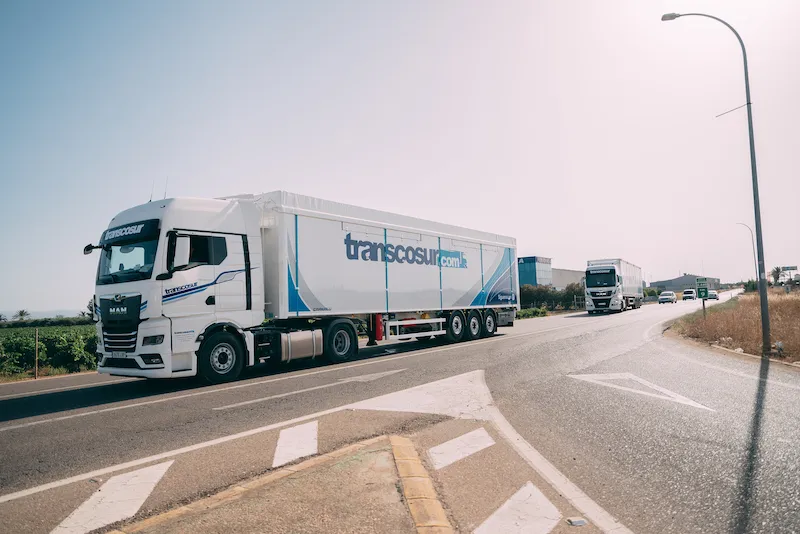
Lorry transit time from Spain to France: hours, breaks and rest
Guides · Published on
Distance does not decide how long a lorry takes: the hours the law allows at the wheel do. Here are the rules of Regulation 561/2006 and the sums done from Andalusia.
Lorry transit time from Spain to France depends less on distance than on the hours the law allows at the wheel. Córdoba to Bordeaux is about 1,080 km by road, and a lorry with one driver cannot cover that in a single working day. This guide explains, using Regulation (EC) 561/2006 and its 2020 reform (Regulation (EU) 2020/1054), how long a driver can drive, when the lorry has to stop and what a second driver changes, then does the sums for several routes from Andalusia. It is general information and a theoretical calculation, not a delivery time.
What is the lorry transit time from Spain to France?
With one driver, a lorry takes in theory just under a full day from Córdoba to Irun on the French border, just over a day to Bordeaux or Perpignan, and nearly two days to Lyon. That is hours at the wheel plus compulsory breaks and rest, before any loading, unloading or weekend stops.
| From Córdoba to | Approximate distance | Hours at the wheel | One driver | Two drivers |
|---|---|---|---|---|
| Irun | 860 km | 11.5 h | about 23 h | about 12 h |
| Perpignan | 1,045 km | 14 h | about 26 h | about 15 h |
| Bordeaux | 1,080 km | 14.5 h | about 27 h | about 15 h |
| Lyon | 1,490 km | 20 h | 34 to 43 h | about 21 h |
The table assumes an average of 75 km/h, which is our own working assumption and not a legal figure. The limit for lorries on motorways is 90 km/h in Spain (Article 48 of the Reglamento General de Circulación) and in France (Article R413-8 of the Code de la route). Distances are approximate and vary with the exact collection and delivery points. On road freight between Spain and France the same sums work in both directions, so a British buyer of goods from Andalusia and a British seller shipping to Seville can both use them for the Spanish and French leg.
How many hours can a lorry driver drive?
A lorry driver can drive nine hours a day, and up to ten hours twice a week. The limit is 56 hours in a week and 90 hours in any two consecutive weeks. That is Article 6 of Regulation 561/2006, and hours driven in Spain count exactly the same as hours driven in France.
The regulation covers goods vehicles over 3.5 tonnes, including any trailer or semi-trailer, wherever they are registered. Everything is recorded on the tachograph, so this is not a rule anyone can stretch by eye. The regulation also bans paying drivers by distance or speed of delivery where that could endanger road safety or encourage a breach (Article 10).
For loads to or from Britain, GOV.UK says assimilated rules apply to vehicles over 3.5 tonnes driving between the UK and an EU country, with the same main limits.
How often does a lorry have to stop?
A lorry has to stop after four and a half hours of driving at most, for an unbroken break of 45 minutes. That break can be split into two, a first of at least 15 minutes and a second of at least 30 minutes, under Article 7. During the break the driver does no other work at all.
On the clock, a nine-hour driving day takes up at least nine and three-quarter hours. A ten-hour driving day takes eleven and a half, because reaching the ninth hour triggers another break.
How much daily and weekly rest is required?
Normal daily rest is 11 hours, which can be cut to 9 hours up to three times between two weekly rests. Normal weekly rest is 45 hours, reducible to 24 with later compensation, and must start within six 24-hour periods of the previous one. Article 8 of the regulation sets out all of these limits.
One detail explains a lot of delays: daily rest must be completed within 24 hours of the end of the previous rest. So the whole working day, including driving, breaks, loading and waiting, cannot run beyond 13 hours with a normal rest, or 15 with a reduced one.
The 2020 reform added two rules that matter on long trips. Regular weekly rest cannot be taken in the cab: it must be in suitable accommodation paid for by the employer. And the operator has to organise work so the driver can get back to base or home every four weeks. Article 12 lets a driver run one hour over, or two after a 30-minute break, to reach base or home for weekly rest, but only in exceptional circumstances and with compensation. It is not something to plan around.
What difference does double manning make?
With double manning, the lorry stops far less. Each driver does their own hours, they swap instead of parking up, and the daily rest of at least nine hours can be completed within 30 hours rather than 24, under Article 8. Since 2020, the 45-minute break can also be taken while the lorry is moving.
That moving break only counts if the resting driver is not assisting the one at the wheel, as Article 7 makes clear. Under those rules, two drivers can put in 18 to 20 hours of driving inside that 30-hour window, enough to reach Lyon in one run. That is why the last column of the table is so much shorter. But it means two people for one load, so it only pays when time really matters.
Lorry transit time from Córdoba to Bordeaux, step by step
With one driver and an average of 75 km/h, leaving loaded on Monday at 07:00, the sums look like this:
- Monday, 07:00 to 11:30: the first four and a half hours at the wheel.
- 11:30 to 12:15: 45-minute break.
- 12:15 to 16:45: another four and a half hours. That is about 675 km, past Burgos.
- 16:45 to 03:45 on Tuesday: 11-hour daily rest.
- Tuesday, 03:45 to 08:15: four and a half hours more.
- 08:15 to 09:00: another 45-minute break.
- 09:00 to 10:00: the last hour to Bordeaux.
It arrives on Tuesday at around 10:00. Stretching Monday to ten hours gains nothing: one more hour is driven, but a second break is needed and the rest starts later. Cutting the rest to nine hours does save two hours, at the cost of one of the three reductions allowed.
What adds time to a road freight job?
What adds most time to a road freight job is not the road: it is waiting at loading and unloading, delivery bay hours, weekend bans and the driver’s weekly rest. Spain and France are both in the European Union, so there is no customs stop between them. A load to or from Britain has customs of its own.
- Loading and unloading: these count as other work, not driving, but they use up the day. In bulk haulage, a queue at the weighbridge or the intake pit can leave a driver with no hours left to carry on that day.
- Weekends in France: vehicles over 7.5 tonnes do not run, with some exceptions, from 22:00 on Saturday or the eve of a public holiday until 22:00 on Sunday or the holiday (French order of 16 April 2021). A yearly calendar adds further dates, which have included summer Saturdays.
- Weekly rest: if it falls mid-journey, that is 24 or 45 hours parked.
- Traffic and weather: roadworks, accidents or snow in the mountains do not change the regulation. The driver still has the same hours.
How do you plan a load with a delivery slot?
A load with a delivery slot is planned backwards: start from the slot at destination, take off the hours at the wheel, the breaks and the rest periods, and see which day that lands on. If the result touches a Saturday night or a Sunday in France, the load moves forward or the delivery moves on.
Three things help a shipper save hours:
- Have the load ready at the agreed time. Two hours lost at collection can cost more than two hours at delivery if they push the driver’s rest to a bad moment.
- Give the real unloading window, with shifts and closed days. A plant taking biomass in fixed slots is not the same as a warehouse open all day.
- Say what is flexible. Knowing which day can move makes it easier to fit the job around the driver’s hours.
At Transcosur we do these sums with you before loading: collection point, destination, unloading hours and what happens if the weekend gets in the way.
Frequently asked questions
Common questions
How many hours can a lorry driver drive in a day under EU rules?
Nine hours, extended to ten twice a week, under Article 6 of Regulation 561/2006. A driver cannot exceed 56 hours in a week or 90 hours in any two consecutive weeks.
Do loading and unloading count as driving time?
No, they count as other work. But they still use up the day: daily rest must be completed within 24 hours of the end of the previous rest, so a long wait at the bay cuts what can be driven that day.
Can a lorry drive through France at the weekend?
With limits. Under French rules, vehicles over 7.5 tonnes do not run, with some exceptions, from 22:00 on Saturday or the eve of a public holiday until 22:00 on Sunday or the holiday. An annual calendar adds further dates.
Are the rules different for a load from the UK?
GOV.UK says assimilated rules matching these limits apply to lorries over 3.5 tonnes driving between the UK and an EU country: nine hours a day, ten twice a week, 45 minutes after four and a half hours. Customs and the Channel crossing add time of their own.
Our services
How we do it
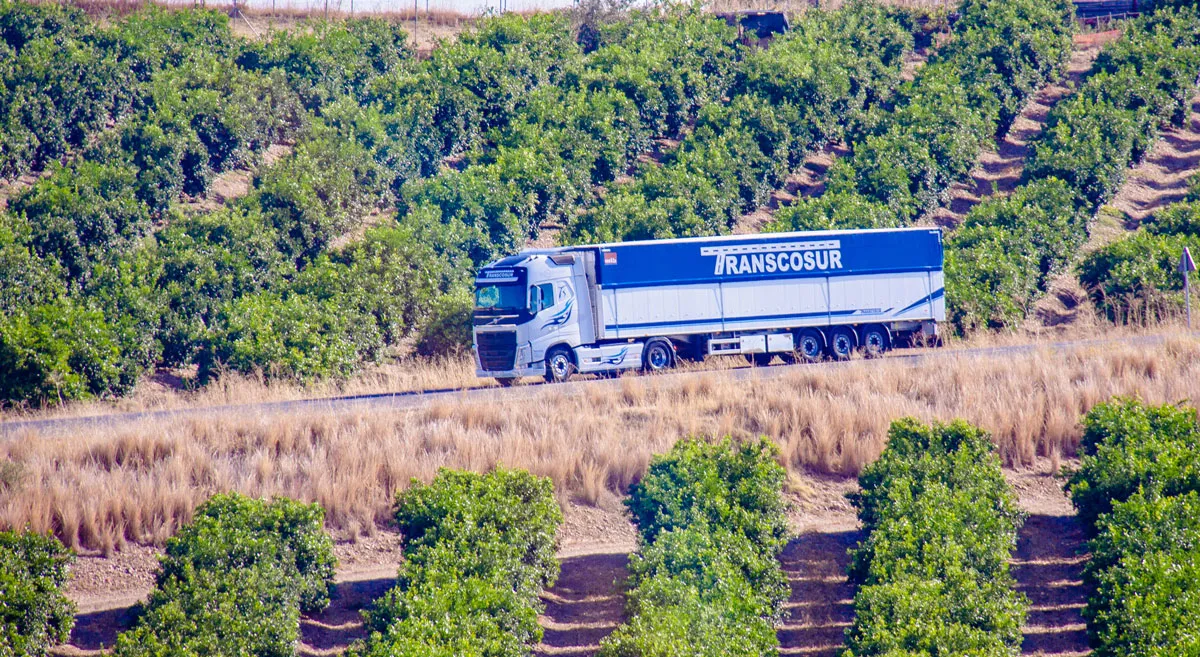
Spain and France
Regular routes between Spain and France in both directions, with bulk in walking floor and tipper trailers, biomass, scrap, palletised freight and groupage.

Bulk haulage
Grain, citrus fruit, wood chip and industrial products carried loose in walking floor and tipper trailers, across Spain, France and Europe.
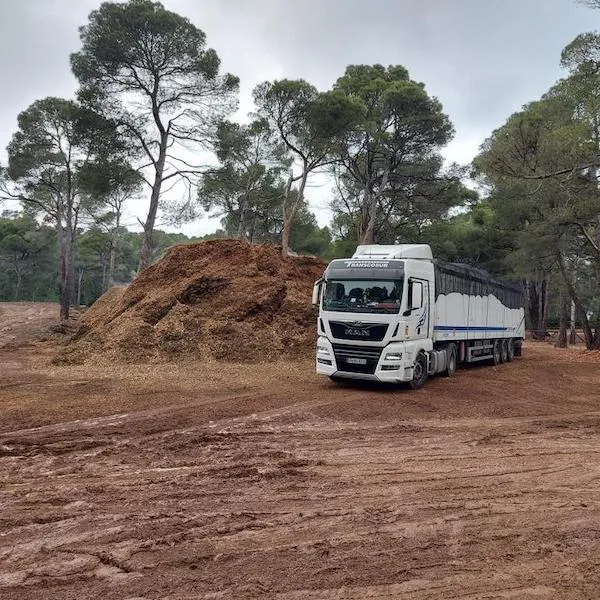
Biomass
Forestry wood chip, pruning waste and other solid fuels in bulk, in high-volume walking floor trailers.
Guides
More guides
CMR consignment note: what it is and how to fill it in
What the CMR consignment note is, when it applies, who fills it in and signs it, which boxes matter, how reservations work and the time limits for making a claim.
Road haulage quote: what information to give, and why it matters
Goods, weight or volume, collection and delivery points, loading, unloading, dates and frequency: what a haulier asks before quoting, and why each detail changes the price.
Get a quote
Request a quote for your load
Tell us what needs moving and between which points. We will call you back with a price and availability.